Online Marketplace Definition: What Is an Online Marketplace and How Does It Work
An online marketplace is a website or app that facilitates shopping from many different sources. The marketplace operator does not own any inventory. Their business is to present a user with the inventory of others and facilitate a transaction. eBay is the ultimate example of an online marketplace. They sell everything to everyone. According to the Online Marketplace Definition there are many other types. These diverse business models provide popular or necessary services in various ways that are meant to simplify or improve customers’ lives.
Since they offer real convenience to consumers, the number of marketplaces has exploded in recent years. If you were to start a department store in 2017, it would be an online marketplace. We also refer to it as Department Store 2.0. Because users electronically access providers’ inventory and the marketplace does not have to own it before offering it to consumers, all products sold by providers are available to consumers, and real-time information about the products is presented on the website or app of an online marketplace. It is a much broader assortment than any store can offer.
Inhaltsverzeichnis
- 1 Online Marketplace Definition: What Is an Online Marketplace and How Does It Work
- 1.1 The Essentials at a Glance
- 1.2 Which Online Marketplace Do You Want to Create?
- 1.3 Online Marketplace Definition: What Is an Online Marketplace?
- 1.4 Which Types of Marketplaces Are There According to the Online Marketplace Definition?
- 1.5 The Most Important Advantages of Marketplace Companies
- 1.6 Efficiency
- 1.7 Revenue Streams
- 1.8 Automation
- 1.9 Value Proposition
- 1.10 A Scalable Business Model
- 1.11 Customer Interest
- 1.12 Analysis
- 1.13 5 Rules for Popular Online Marketplaces:
- 1.14 Disadvantages of Marketplaces According to the Online Marketplace Definition
- 1.15 Comparison of a Traditional Retailer with an Online Marketplace
- 1.16 Responsibilities of the Online Marketplace
- 1.17 Challenges for Online Marketplaces According to the Online Marketplace Definition
- 1.18 What Are Motivating Marketplaces?
- 1.19 Conclusion
- 1.20 Free Consultation
- 1.21 More Articles
| Online Marketplace Definition – Overview | |
| ⭐ Definition: | An online marketplace connects buyers and sellers. |
| 🏆 Development time: | From 3 months |
| 💰 Costs: | Project-specific |
| ⚡ Technologies: | CMS or custom programming |
The Essentials at a Glance
The task of online marketplaces is to bring sellers and buyers together. Unlike an online shop, items can also be auctioned here. Creating online marketplaces is more complex than developing an online shop. The majority of providers operate in the B2C sector, while significantly fewer providers are found in the C2C segment. For electronic marketplaces to be successful, they must absolutely consider the needs of both buyers and sellers. Well-known marketplaces include Amazon and eBay.
Which Online Marketplace Do You Want to Create?
EXAMPLE |
RATING |
SPECIAL FEATURES |
FURTHER INFORMATION |
|---|---|---|---|
 Complex online marketplace |
RATING: 9.8 |
|
FREE ADVICE |
 Extended online marketplace |
RATING: 8.2 |
|
FREE ADVICE |
 Simple online marketplace |
RATING: 7.3 |
|
FREE ADVICE |
Online Marketplace Definition: What Is an Online Marketplace?
An online marketplace is a website or app that directly connects buyers and sellers based on the P2P (peer-to-peer) business model. The marketplace operator charges a percentage fee on each sale between users for their service. Goods are traded via auction and are generally not sold.
Which Types of Marketplaces Are There According to the Online Marketplace Definition?
There are three types of marketplaces:
Vertical Marketplaces:
A vertical marketplace is an online marketplace that, by definition, sells products from many sources, but they are all of a single type. For example, TrueFacet.com sells only jewelry and related products. The website performs the important task of guaranteeing authenticity and, because jewelry is such a high-quality product, this is a significant added value. By assigning each piece of jewelry a unique identifier when it is listed on the website, it creates added value by verifying the authenticity of a product. This special service appeals to customers who place extra emphasis on the authenticity of their jewelry.
Horizontal
An example of a horizontal marketplace according to the Online Marketplace Definition is Dote. Dote offers women who do not want to download individual retail apps the opportunity to shop simultaneously from several retailers, including Madewell, Forever 21, J. Crew, Lululemon, Brandy Melville, Topshop, Free People, Ann Taylor, Loft, Zara, and others. Users can view products from various retailers together and at the same time in the same app. Dote focuses on a specific type of customer and offers them multiple products from many different kinds of retailers. For these customers, using Dote means greater convenience and saves time and effort since they do not have to download and install an app from each retailer.
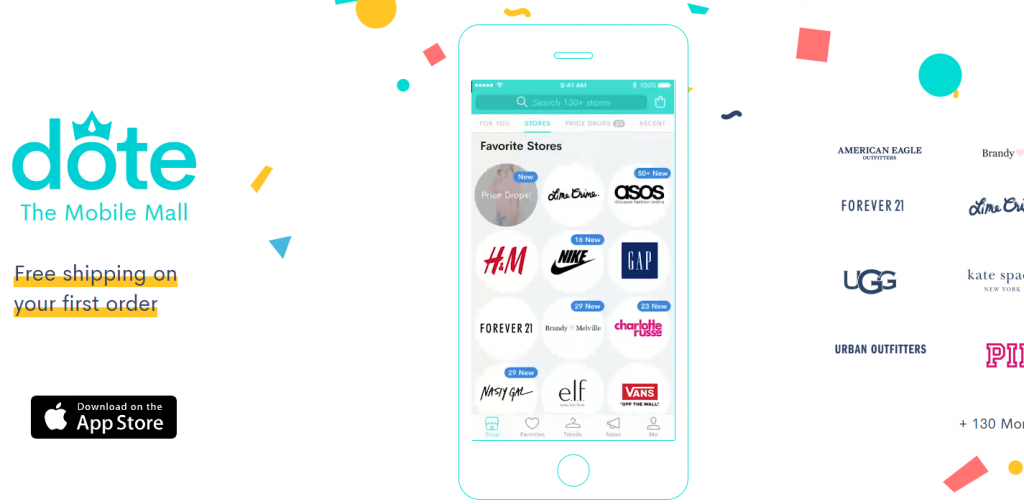
Dote is an example of a horizontal online marketplace.
Global
A global marketplace is, according to the Online Marketplace Definition, an online marketplace that sells virtually everything. The ultimate example of this is eBay. eBay has 167 million users, over 1 billion items for sale, more than 80% of the items are new, and this year almost 90 billion euros worth of products will be sold. Global online marketplaces mostly rely on an enormous assortment of goods to serve an equally enormous customer base. It is important for global marketplaces that they have high brand recognition so that they attract a correspondingly large number of customers.
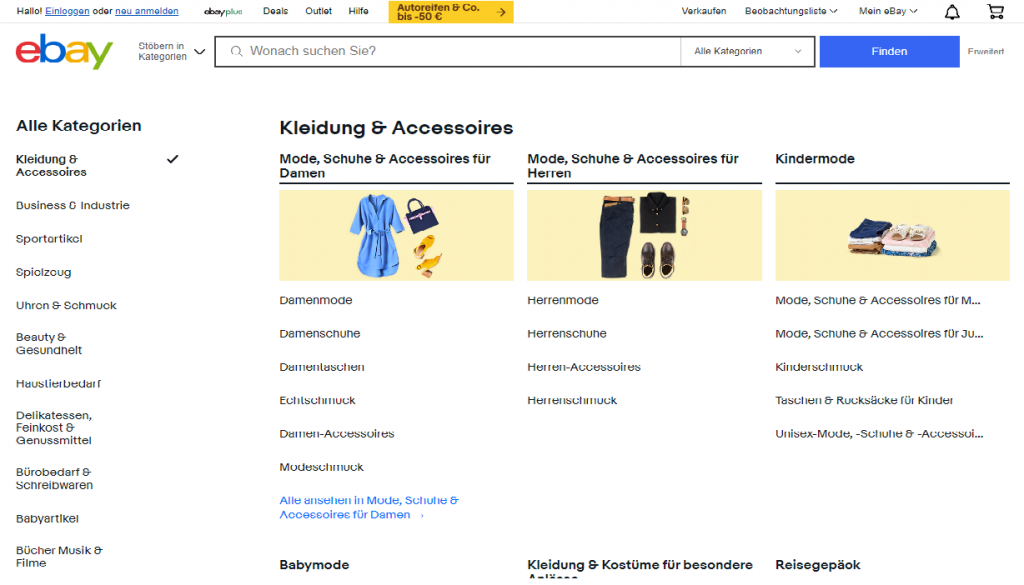
eBay is one of the classics when it comes to so-called global marketplaces.
Hybrid
Hybrid marketplaces offer both their own products and products from other companies and, according to the Online Marketplace Definition, provide participants with a platform to complete transactions. Hybrid online marketplaces have many advantages and few disadvantages, which is why they are growing in popularity. In particular, they offer providers a good opportunity to offer additional products—even if they only manufacture or distribute a few products themselves—in order to quickly spark and increase consumer interest.
Marketplace – Typical Features According to the Online Marketplace Definition
Typical features according to the Online Marketplace Definition include the following:
• Product Upload ‘Verification’ Showcase Management
• Customer Account with WOW Features
• Ad Management, Campaign Manager
• Customer Retention, Rewards, Recognition Tools
• Multiple Payment Options
• Logistics Management, Panel
• Customer Support, Ticket Management
• Frontend with Multiple Stores
• Multi-Currency, Multilingual
• Distributed Hosting, Load Balancing
• Traffic Routing (Geo-based)
• Data Mining, Business Intelligence Tools
• Automated Tax Calculation
The Most Important Advantages of Marketplace Companies
In light of marketplace growth and the still untapped areas of this technology, business owners with their own online shop can utilize the marketplace model and develop their own unique solutions. Below, according to the Online Marketplace Definition, you will find some important advantages of operating your own marketplace. The future looks bright for internet marketplaces.
A Hamburg merchant successfully sells her products via platforms such as Shopify and Etsy, which serves as inspiration for other retailers.
Efficiency
The costs for launching a marketplace application are almost the same as the costs for launching an e-commerce website. Although the logic behind an e-market is quite complex, its functionality can meet the specific needs of many different providers. Efficiency is often achieved through precise planning, with the calculation of costs also playing a major role. Therefore, a clear focus of the marketplace is important, as a vague concept often leads to an increase in projected costs due to confusion or a lack of understanding of the exact Online Marketplace Definition.
Range |
Development days |
Budget |
|---|---|---|
| Core functionalities | From 20 development days | From € 12,500 |
| Extended functionalities | From 10 development days | From € 5,000 |
| Complex functionalities | From 10 development days | From € 5,000 |
Revenue Streams
Marketplace owners can choose a revenue stream that best suits their market niche and aligns with their business goals. The way in which marketplace owners generate revenue determines the success of their platform. According to the Online Marketplace Definition, the most popular monetization models are commissions, listing fees, subscriptions, lead generation fees, advertising, and the provision of additional services. The fees charged based on sales should be considered when choosing the marketplace in order to find the most cost-effective options for sellers. You can use a combination of several monetization schemes, but it is best to implement only one at the beginning.
For example, Craigslist and OLX earn their money with premium listings. The most successful marketplace companies such as Booking.com, eBay, Etsy, and Uber use the commission business model.
Automation
According to the Online Marketplace Definition, the main revenue stream of a marketplace is the commission it earns from sales. This requires a high degree of automation of business processes. There is no need to handle major formalities, as everything is done automatically within the platform. This business model offers providers a great deal of convenience at first glance. However, it carries a certain risk, because automation means there is only a limited control over the process. In the event of errors, intervention is difficult and can have lasting consequences.
Value Proposition
According to the Online Marketplace Definition, marketplaces provide companies with an excellent opportunity to manage their supply without an initial investment in a physical store. Suppliers can create a kind of business card with ratings and customer reviews so that customers can make informed decisions. To attract product and service providers as well as customers, a marketplace can offer lower fees, greater revenue potential, a better user experience, a more attractive brand, and a safer app environment than limiting reach to a physical location. This comprehensive service makes shopping on a marketplace particularly attractive for customers.
A Scalable Business Model
According to the Online Marketplace Definition, a marketplace entails less financial risk than an e-commerce shop since it does not have to invest in inventory. However, marketplaces are likely to grow quickly. And when traffic grows rapidly, it may be necessary to add more providers to meet demand. Therefore, the only challenge for a marketplace owner is to balance supply and demand. High-quality providers attract more customers, while a growing customer base attracts more providers. This scalable business model is ideal for extensive online marketplaces that aim to operate globally and cater to a correspondingly large customer base.
Focus |
Simple marketplace |
Complex marketplace |
|---|---|---|
| |
||
| |
|
|
| |
|
|
| |
||
| |
||
| |
||
| |
||
| |
On request | On request |
Customer Interest
One of the main attractions of an e-market is that it brings together offers from multiple providers or service providers. Customers are more likely to use an app with a wide range of options, so they can choose exactly what they want without being limited to a single provider. However, due to oversupply these days, it is often difficult to capture customer interest. Therefore, for newcomers, only niches that have not yet been occupied typically offer opportunities.
Online marketplaces are useful for connecting buyers and sellers and are also helpful because they handle payment and order processing, which provides an additional level of security for consumers and support for sellers. Sometimes, online marketplaces are used even after purchase when there is an issue that needs to be resolved. According to the Online Marketplace Definition, the role of intermediary between customers and sellers is one of the preferred tasks of a marketplace.
Analysis
Marketplace owners can track their sales with precise metrics. For example, an owner can see which products and services are in demand and which providers are most preferred. In this way, the owner can promote goods and services that are truly important to their users. A comprehensive analysis of transactions reveals both the strengths and weaknesses of the current state of the marketplace. Thanks to this analysis, the operator can eliminate weaknesses and thus optimize the marketplace.
5 Rules for Popular Online Marketplaces:
-
- Vertical marketplaces tend to grow faster. Horizontal retail platforms face fierce competition and require a complex approach. For example, eBay works hard to balance supply and demand in numerous smaller market segments. While users visit Uber or Lyft for a simple reason – to find a ride. According to the Online Marketplace Definition, vertical marketplaces can better meet specific requirements than other typical business models.
- Grow locally before expanding internationally. Nowadays, social media apps like Facebook, Instagram, Twitter, and others enable efficient early growth through targeted ads and geotagged posts. Such an approach can also be used to validate your startup idea.
- Curation helps in making better decisions. By utilizing data, e-commerce business owners can coordinate customer supply and ensure better quality for both sides. Curated platforms can, according to the Online Marketplace Definition, ensure that providers set appropriate prices while consumers buy from high-quality retailers.
- Consider the niche within a niche. According to the Online Marketplace Definition, market size is less important than potential. Consider not only obvious market segments but also think of shadow segments. For example, Rover.com is a marketplace for dog sitters that connects dog parents with local pet sitters. Only one in ten dog owners uses a kennel, so Rover refers to the remaining nine potential users.
- Success should not be the end goal. When your online business starts to grow, you should take advantage of new opportunities to not only increase revenue but also raise the market standard. Besides financial benefits, such an approach improves seller loyalty and increases bonding between companies, which according to the Online Marketplace Definition is one of the most important success factors for an online marketplace.
- Vertical marketplaces tend to grow faster. Horizontal retail platforms face fierce competition and require a complex approach. For example, eBay works hard to balance supply and demand in numerous smaller market segments. While users visit Uber or Lyft for a simple reason – to find a ride. According to the Online Marketplace Definition, vertical marketplaces can better meet specific requirements than other typical business models.
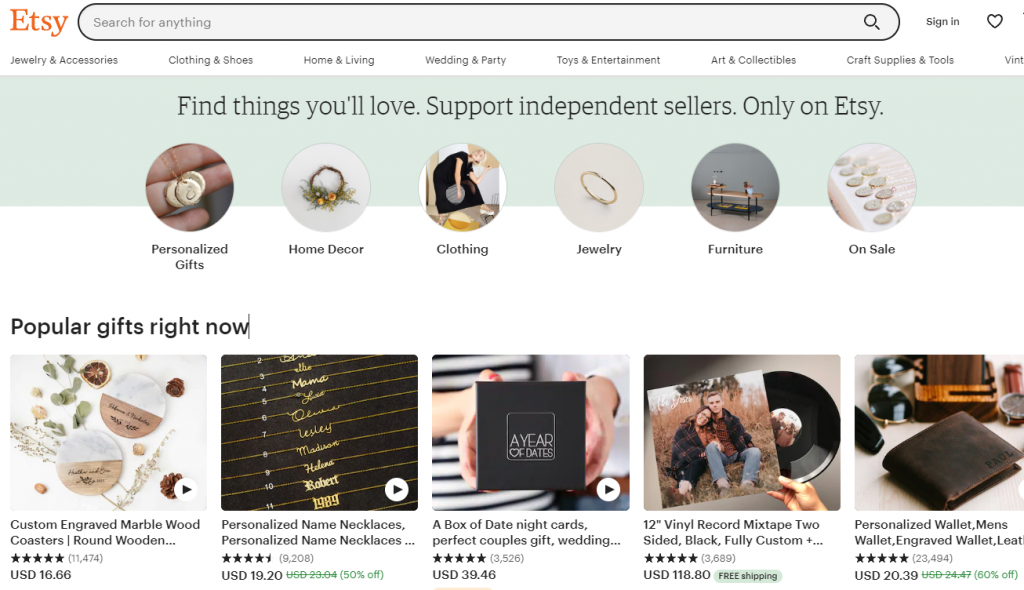
E-Commerce platforms such as Etsy offer sellers additional services and thereby provide the opportunity to increase the gross margin by 10% annually.
Disadvantages of Marketplaces According to the Online Marketplace Definition
I am text block. Click edit button to change this text. Lorem ipsum dolor sit amet, consectetur adipiscing elit. Ut elit tellus, luctus nec ullamcorper mattis, pulvinar dapibus leo.
Comparison of a Traditional Retailer with an Online Marketplace
I am text block. Click edit button to change this text. Lorem ipsum dolor sit amet, consectetur adipiscing elit. Ut elit tellus, luctus nec ullamcorper mattis, pulvinar dapibus leo.
Responsibilities of the Online Marketplace
I am text block. Click edit button to change this text. Lorem ipsum dolor sit amet, consectetur adipiscing elit. Ut elit tellus, luctus nec ullamcorper mattis, pulvinar dapibus leo.
Challenges for Online Marketplaces According to the Online Marketplace Definition
I am text block. Click edit button to change this text. Lorem ipsum dolor sit amet, consectetur adipiscing elit. Ut elit tellus, luctus nec ullamcorper mattis, pulvinar dapibus leo.
What Are Motivating Marketplaces?
In almost every type of e-commerce today, there is one thing that drives everyone to move faster and more efficiently: Amazon.com. Nothing is as motivating as a major competitor with nearly unlimited resources, technological capabilities, and potential. According to the Online Marketplace Definition, Amazon itself is a hybrid marketplace that offers products from both its own and other companies while simultaneously providing a platform for buyers and sellers to conduct various types of transactions either independently or with Amazon’s assistance.
There are many other hybrid marketplaces. Numerous large and small companies, including now Walmart—the second-largest e-commerce site in the country according to the Online Marketplace Definition by comScore—enable users to offer their own products on marketplaces that emerge on various e-commerce websites. When well managed, these marketplace additions to e-commerce websites bring more traffic and a broader range of products, giving consumers more reasons to stay on one site rather than switch.
As the appeal of department stores declines, marketplaces seem to be one of the areas replacing the multi-brand retailer. We are now witnessing an explosion of marketplaces. For marketplaces to be successful according to the Online Marketplace Definition, they must excel in three areas:
- Reducing friction in selling and buying to create sufficient liquidity on both sides of the market.
- Creating a greater level of trust and transparency to encourage participation.
- Establishing both proactive and reactive mechanisms to handle the inevitable issues that arise among marketplace participants.
To develop the best online marketplace, these are the key concerns that should be considered according to the Online Marketplace Definition:
- Chicken and egg problem: Attracting sellers to convert consumers.
- User-friendly interface for both buyers and sellers
- Safety and reliability: reasonable prices, responsible merchants, and secure transaction software.
- Marketing and strong community support

I am text block. Click edit button to change this text. Lorem ipsum dolor sit amet, consectetur adipiscing elit. Ut elit tellus, luctus nec ullamcorper mattis, pulvinar dapibus leo.
Conclusion
Free Consultation